Not Geography Geography Lesson 15
The Mother Of All Ice Cubes
As I was walking home from the supermarket today with a backpack full of shopping, sweating a fair bit, I would have been very grateful for one of those 'ice snakes' that they are using at Wimbledon. And on that note, today's post is gonna be about ice; more precisely the giant iceberg that has recently broken away from Antarctica (cue Celine Dion).
The Miracle of [Baby Iceberg] Birth
Glacial landscapes are some of the most dynamic in the world, as they are constantly growing at their source end, moving across the land, and eventually melting (ablation) or meeting the sea. When the two meet, the ice can extend out on top of the water for many many miles to form an ice sheet. Icebergs are born when physical factors like melting and gravity cause the end chunk (known as the ice-front) of an ice shelf to break off and float away looking for big ships to sink. This process, the breaking off/floating away part not the big ships part, is called 'calving' - an unnecessarily cute name for what is quite a terrifying phenomenon.
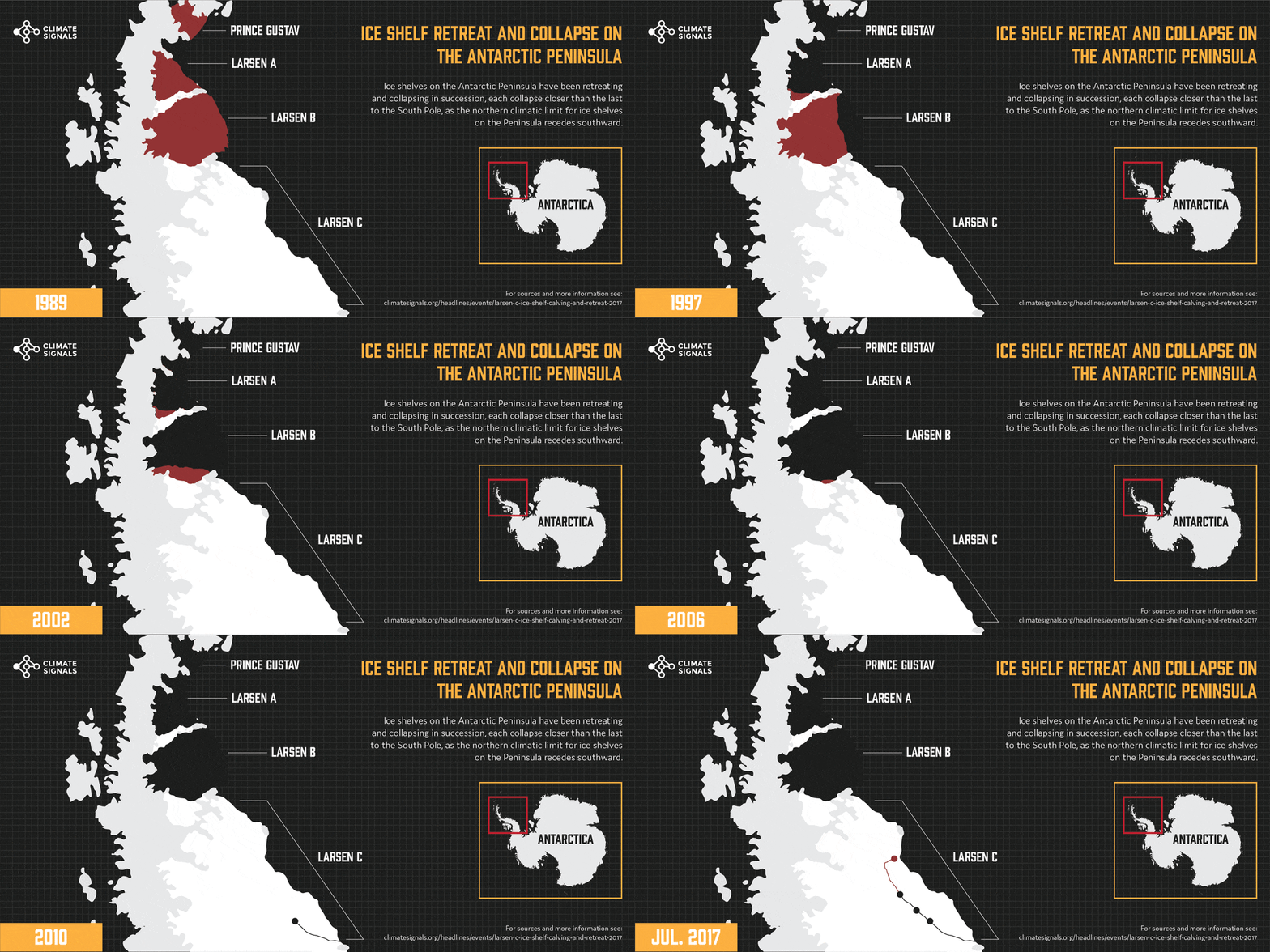
Whilst calving is a natural thing, it has become more studied in recent decades because of its potential links to climate change and global warming. As the adverts with sad polar bears suggest, more and larger icebergs are calving as a result of increased ice melting at earth's poles. And their melting into the oceans is contributing to sea level rise that threatens many major world cities on the coasts. Hence, when scientists noticed several fractures across the four sections which make up the Larsen Ice Shelf on the Eastern edge of Antarctica, they presented a cause for concern.
Gonna Need a Bigger Glass
From its discovery in 1890, the Larsen Ice Shelf remained stable for 100 years and it was assumed that it would remain so until sections A and B began rapid disintegrations in 1995 and 2002. Hence, scientists began closely monitoring section Larsen C, which is the fourth largest ice shelf on the continent, under an operation called Project MIDAS. They watched the shelf using satellites and field work, and in 2014 found a fracture around 70 miles long and rapidly growing.
It was this fracture which this year led to 12% of Larsen C breaking off, forming a monster iceberg.
This behemoth is the equivalent size of half of Wales (with less sheep), or two Luxembergs, and has a depth of two Statue of Liberty's. It weighs a staggering 1 million tonnes. There is not enough gin or tonic water in the world for this guy.
So is This a Sign of Things to Come?
Before everyone rushes out to panic buy waders, Dr. Andrew Luckman who heads the MIDAS project has said that the Larsen C calving incident is not likely to be caused by global warming, as the shelf has actually been thickening in recent decades, and fractures have been naturally occurring for thousands of years. The sandbags can also be piled back into the shed, because he also assured that as the berg is already in the water, there will be minimal sea level rise - only 1cm, not even enough to fill a paddling pool!
Whilst this particular story doesn't have a Titanic-esque ending, there is still general consensus that increasing global temperatures are shrinking the earth's glacial bodies. Unfortunately, the earth interacts with the sun's radiation in such complicated and complex ways that even the combined brain power of all the characters played by Benedict Cumberbatch wouldn't be able to figure it out (Looking at you Doctor Strange).
That's all for this post, hope you have a coooooool week!
P.S - Marvel at how informative and helpful this Gif is!